To: our friends who travel often to Orion and Andromeda
 Maps
Maps
Features
Directions to wherever you're going
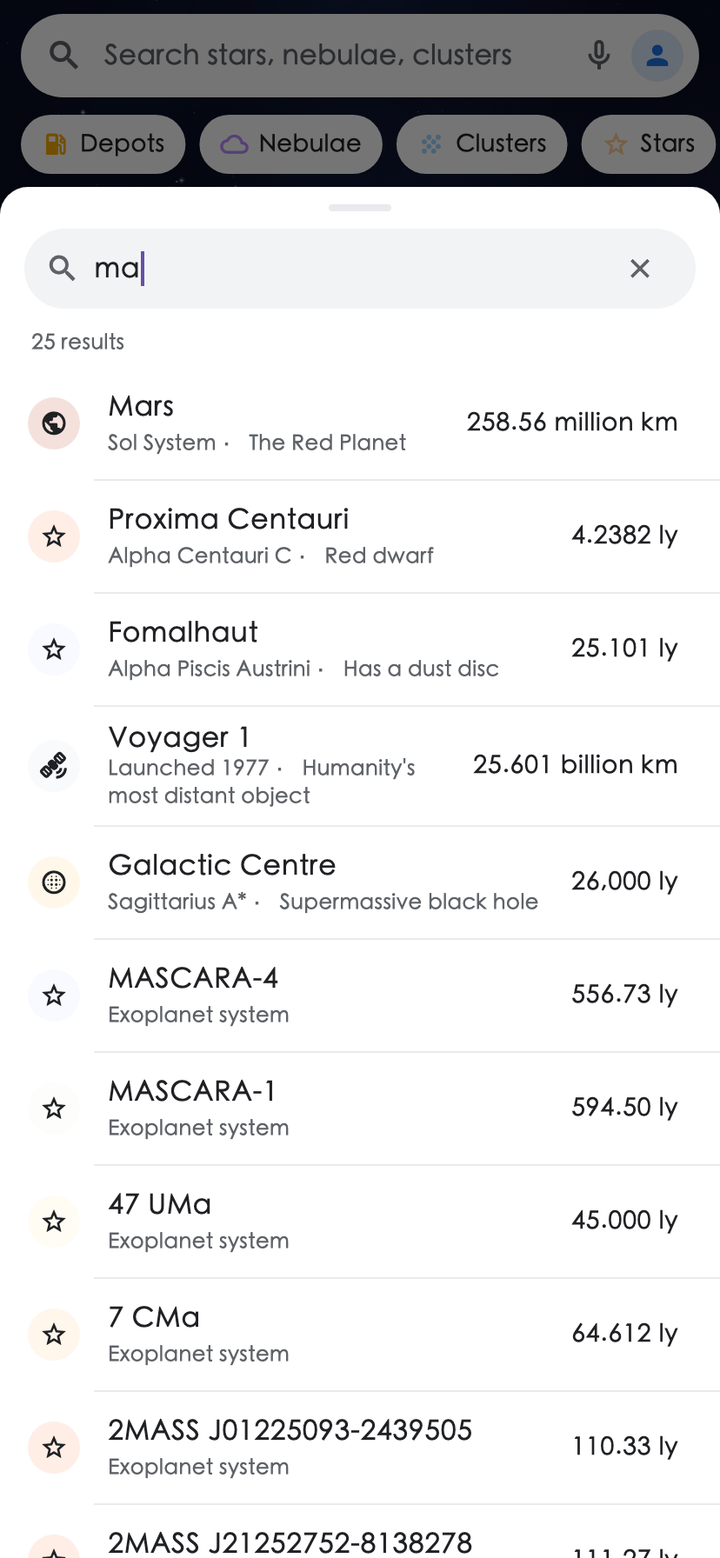
Place search
Suggestions appear as you type. Names are matched in both languages, along with common aliases. Results are sorted by distance from you.
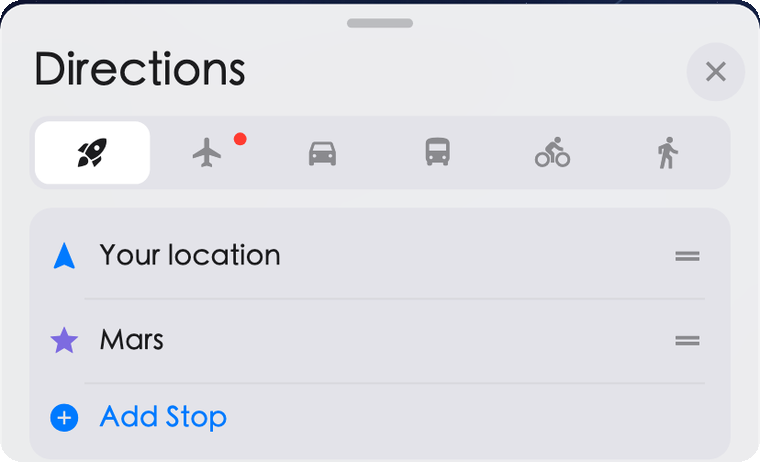
Directions
Each way to travel is planned separately, and the fastest is labelled. Most destinations offer two or three options, including "leave now" and "wait for it to come to you".
Departure time
Pick when you want to leave, and the journey is planned around it.
Offline
No connection needed, no account required. Useful around Alpha Centauri, where there is currently no coverage.
Ways to travel
Five ways to travel
Switching changes the route itself, not just the number.
| Way to travel | Cruising speed | To Alpha Centauri 4.37 light years |
CO₂ to Mars one way |
|---|---|---|---|
| 🚀 Interstellar | Light speed | 4 yr | 1.25 million t |
| 🛰️ Crewed rocket | 60,840 km/h | 83.4 million yr | 2,883 t |
| 🚗 Driving | 110 km/h | 12.8 billion yr | 6,913 t |
| 🚲 Cycling | 20 km/h | 103.4 billion yr | 282 t |
| 🚶 Walking | 5 km/h | 271.8 billion yr | 463 t |
Cycling has the lowest emissions. Walking is slightly higher, because you are breathing and food has a carbon footprint.
Departure suggestions
Avoid rush hour,
or an entire century
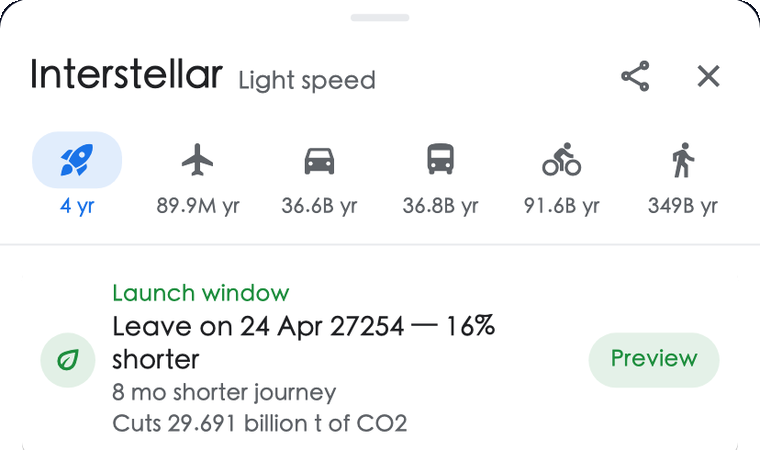
UnivMap picks the best day to set off on. The planets keep moving, so leaving a day earlier or later can matter quite a lot.

The best day is usually different for each way of travelling. "Preview" shows how the planets will be arranged that day.
Traffic
Check before you go
Conditions are colour-coded along the route. Advisories cover restrictions on the way.
Honest estimates
If you can't get there,
it says so
Some destinations are moving away, faster than you can travel. The estimate then reads ∞ yr and the launch button is greyed out.
Voyager 1 travels at 60,906 km/h. The crewed rocket travels at 60,840 km/h. The difference is 66 km/h.
Directions from Earth to Voyager 1.
Coverage
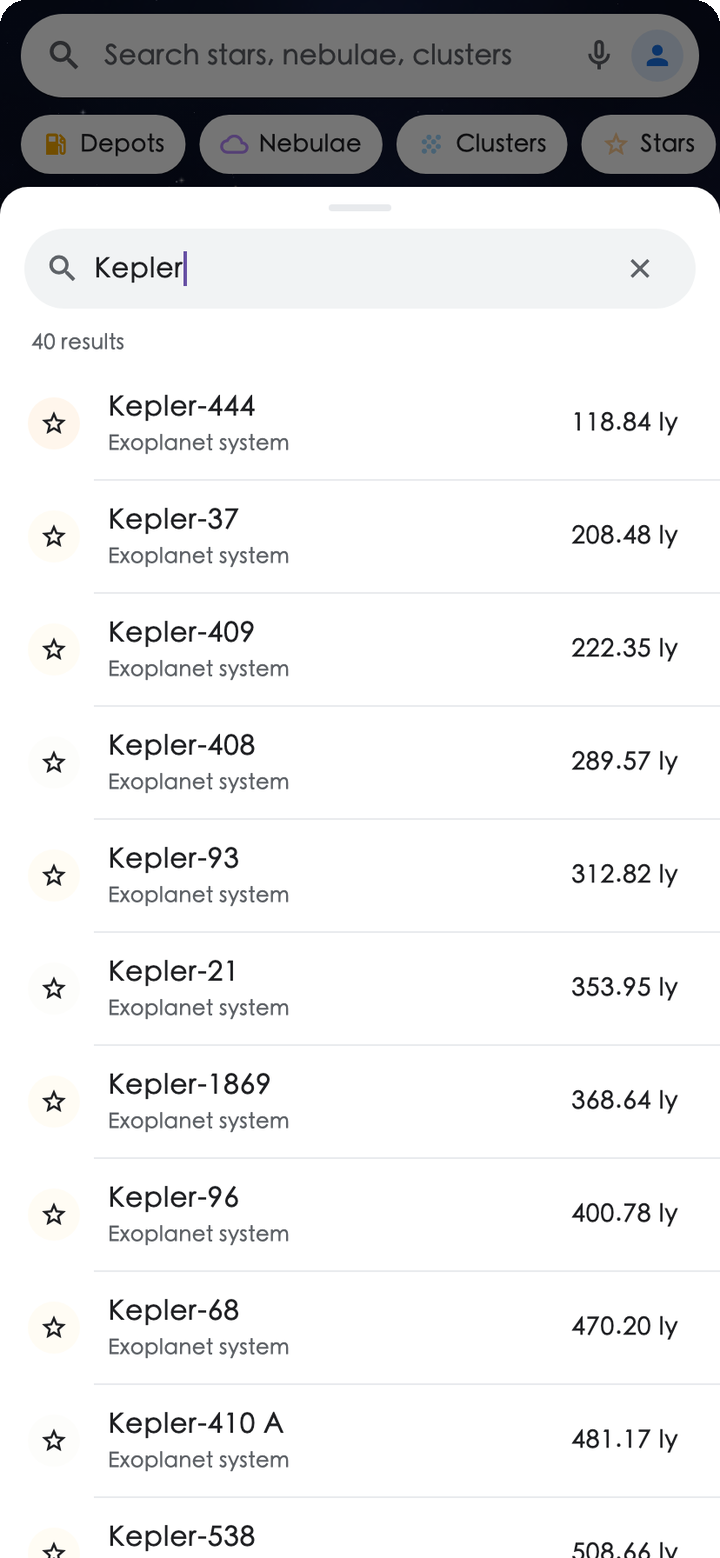
48,109 objects
Planets and moons of the solar system, stars, galaxies, clusters and nebulae, and five probes still in flight.
| Galaxies | 26,687 |
| Stars | 12,637 |
| Exoplanets | 6,320 |
| Clusters | 2,346 |
| Planets and moons | 84 |
| Nebulae | 29 |
| Space probes | 5 |
| Galactic core | 1 |
The map zooms all the way from the whole galaxy down to the Moon's orbit around Earth, and the timeline runs forwards or backwards.
Data
Places come from public astronomical databases
FAQ
Things you might want to know first
How long does it take to drive to Alpha Centauri?
About 12.8 billion years at 110 km/h, over a distance of 4.37 light years. Check traffic before you leave and allow time for rest stops.
How long does it take to walk to Mars?
About 7,212 years. If you take the suggested departure date and leave 384 days from now, the journey is 5,424 years shorter.
What is the fastest way to get to the Moon?
The crewed rocket, at 3.0 days of flight time — matching the 73 hours 5 minutes Apollo 11 actually coasted.
The Moon has no launch window, so you can leave on any day.
Why can't I catch up with Voyager 1?
It travels at 60,906 km/h. The crewed rocket travels at 60,840 km/h. The difference is 66 km/h.
The estimate for that route reads "∞ yr", labelled "It outruns you". The distance is still shown: 25.818 billion km.
Does UnivMap need an internet connection?
No. Every place is stored on your phone, so it works the moment you open it, and no account is required. There is no coverage around Alpha Centauri.
Ready to set off?
Check the launch window first. The next departure for Mars is in 454 days.